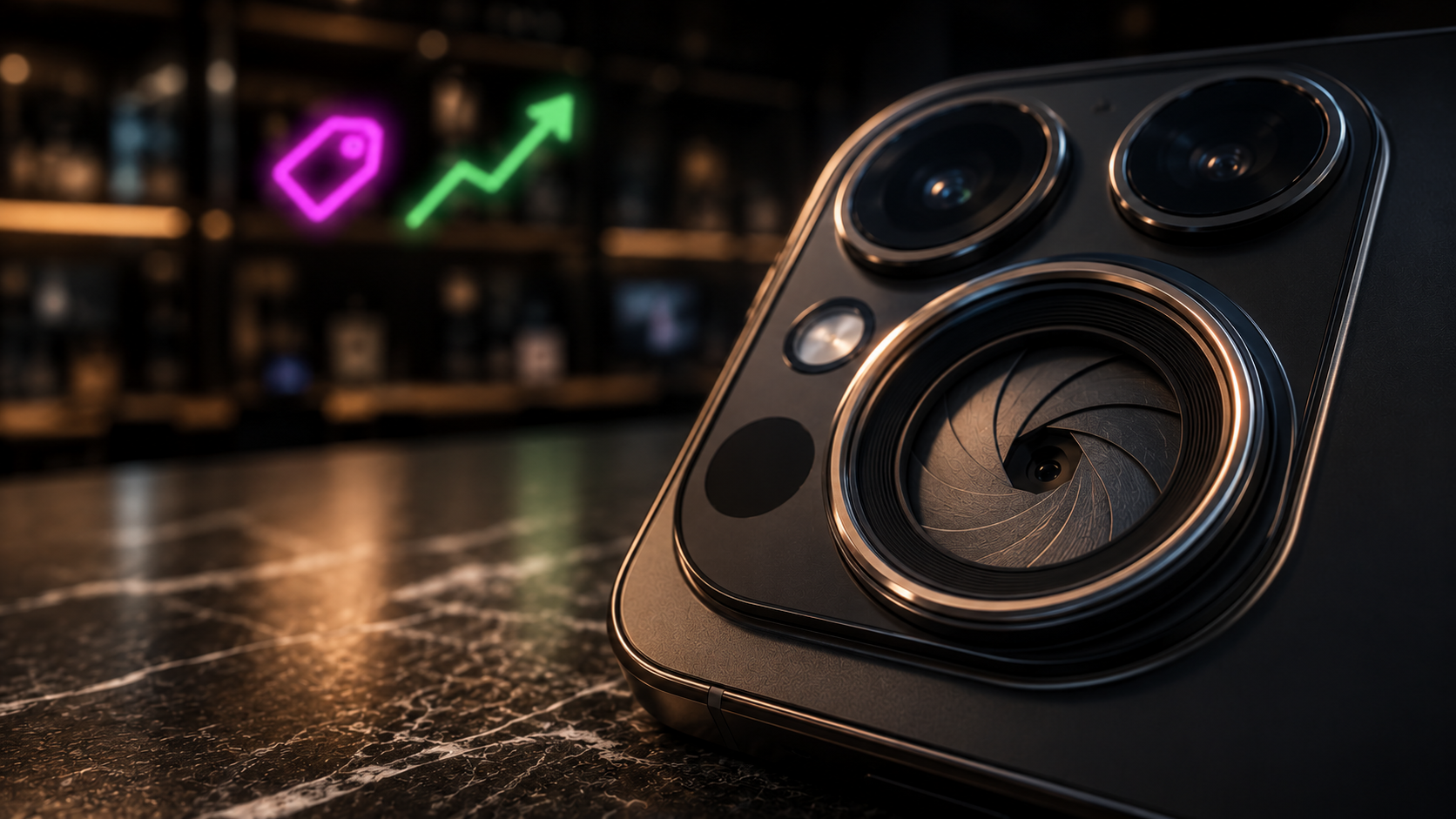
For nine years, every iPhone main camera has shared one quiet limitation. The aperture, the opening that lets light into the lens, has been fixed. The iPhone 14 Pro, 15 Pro, 16 Pro, and 17 Pro all sit at f/1.78 and never move. Everything clever Apple does with depth of field, the blurred backgrounds in Portrait mode, the exposure balancing in bright sun, happens in software after the photo is taken.
The iPhone 18 Pro is rumored to change that. According to supply chain analyst Ming-Chi Kuo, the main camera will gain a variable aperture: a tiny mechanical iris that physically opens and closes inside the lens. It is the single most requested camera hardware change in years, and it is the kind of thing that separates a phone camera from a real one.
There is a catch, and it is the reason this story is making headlines. Kuo says the new part costs Apple roughly 50 percent more than the lens it replaces. That does not automatically mean a higher price tag, but it does change the math, and in Algeria it changes it more than in most places.
What a variable aperture actually does
Think of the aperture as the pupil of an eye. In a dark room your pupil opens wide to gather light. In bright sun it shrinks to a pinhole. A camera aperture works the same way, except until now your iPhone's pupil has been glued open at one size.
A variable aperture adds a ring of moving blades that can widen or narrow the opening on demand. Open it up (a low f-number like f/1.4) and you pull in maximum light for night shots, with a naturally shallow, creamy background blur. Close it down (a higher f-number like f/2.8 or beyond) and more of the scene stays sharp from front to back, which is exactly what you want for landscapes, group photos, or product shots.
The key word is optical. Today's Portrait mode guesses where the background is and blurs it with an algorithm. It is good, but it makes mistakes around hair, glasses, and leaves. A real aperture does the blur with physics, the same way a professional camera does, so the result looks more natural and the edges stay honest.
Kuo's report points to the variable aperture landing on the main 48-megapixel camera, not the ultrawide or telephoto. The exact range is not settled, but the rumored figures sit somewhere around f/1.4 to f/2.8: wider open than today's fixed f/1.78 at one end, and meaningfully tighter at the other.
Why it costs more to build
Moving parts are expensive parts. A fixed lens is a sealed stack of glass with nothing to wear out. A variable aperture adds a miniature mechanism with blades and an actuator (the little motor that drives them), and it has to open and close thousands of times without drifting out of alignment or letting in dust.
That complexity is what Kuo is pricing. He estimates the new module costs Apple about 50 percent more than the seven-element plastic lens used in the iPhone 17 Pro's main camera. Apple's suppliers are already gearing up: Sunny Optical is reported to be making the actuators, with LG Innotek handling module assembly at its plant in Gumi, South Korea, ahead of a launch expected in the autumn of 2026.
Will it actually cost you more?
Here is the nuance the headlines skip. A part costing Apple more is not the same as the phone costing you more. Those are two different numbers, and Apple decides the gap between them.
In fact, another well-known analyst, Jeff Pu of GF Securities, expects Apple to take an aggressive pricing stance on the iPhone 18 Pro, keeping the starting price flat or close to it. The thinking is that Apple is squeezing savings out of other parts to absorb rising costs elsewhere (memory chips have become notably more expensive), so a pricier camera does not have to mean a pricier phone on the shelf in New York.
For most of the world, that is reassuring. For Algeria, it is only half the story.
What this means for buyers in Algeria
There is no official Apple Store in Algeria. iPhone prices here are set by importers, the parallel market, and above all the dinar's exchange rate against the dollar and euro. That has two consequences worth keeping in mind.
First, even if Apple holds the global launch price flat, the local price can still climb if the exchange rate moves or if importers treat the new camera as a premium selling point. A flat price in California does not guarantee a flat price in Algiers.
Second, the Pro models already carry the steepest markup in the lineup once they land here. A variable aperture is a genuine upgrade, but it is also a feature most people will use on automatic without ever touching the f-number. Before paying the Pro premium for it, it is worth asking honestly how you shoot.
If you mostly post to Instagram and WhatsApp, last year's iPhone 17 Pro, the standard iPhone 18, or a strong Android flagship will give you most of the photo quality for noticeably less money. If you actually chase low-light shots and manual control, the variable aperture is the most exciting reason to wait for the Pro.
The honest bottom line
This is still a rumor, even if a credible one. Apple has cut features late in development before, and final specs can shift. But the supply chain signals are strong, and a variable aperture has been on Apple's roadmap for years, so the iPhone 18 Pro is the most likely place for it to finally arrive.
It is worth remembering that Apple is not first here. Samsung shipped a dual-aperture camera on the Galaxy S9 back in 2018 (it switched between just two settings, f/1.5 and f/2.4), and Huawei's Mate 50 Pro went further with a continuously variable f/1.4 to f/4.0. Apple's pattern is rarely to invent a feature; it is to arrive late and make it work so smoothly that it finally feels mainstream. If the iPhone 18 Pro does that for variable aperture, it will be a real upgrade, and for once the marketing will be telling the truth.
When it launches and local prices settle, you will be able to line it up against the alternatives right here on Nestphones and decide whether the new camera is worth what Algeria's market ends up charging for it.


